
Our Services
Sale of petroleum products BONNY LIGHT from the company NNPC


Why Bonny Light Crude Oil Remains a Top Choice for Global Buyers
Introduction
In the competitive world of global crude oil trading, not all crude grades are created equal. One name that consistently ranks among the most sought-after is Bonny Light Crude Oil, a premium grade produced primarily in Nigeria’s Niger Delta. Favored by refiners from the United States to India and Europe, Bonny Light’s popularity stems from a unique blend of chemical properties and logistical advantages. This article explores the key quality features that make Bonny Light Crude Oil highly attractive for traders, refiners, and long-term energy investors.




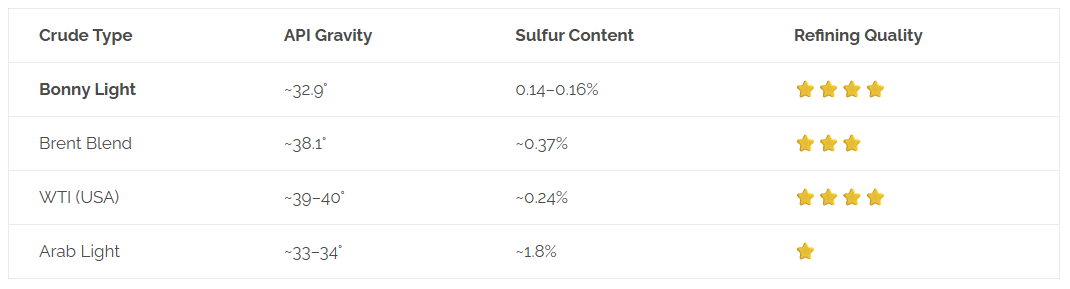
Bonny Light has an API gravity of approximately 32.9°, which places it firmly in the “light crude” category. This means the oil is less dense and more fluid, allowing it to yield a higher percentage of high-value products like:
Gasoline (petrol)
Diesel
Jet fuel
Light crudes like Bonny Light are easier and cheaper to refine compared to heavier oils, offering better margins for refiners.
With a sulfur content of just 0.14–0.16%, Bonny Light qualifies as a “sweet” crude oil. This is a major competitive advantage because:
It produces fewer pollutants when refined.
Refiners require less desulfurization equipment, reducing processing costs.
It complies more easily with strict environmental regulations in markets such as the EU and the U.S.
Bonny Light’s chemical structure is paraffinic, meaning it contains long-chain hydrocarbons that are ideal for producing high-demand fuels. Its refining output tends to favor:
Middle distillates like diesel and kerosene
Low residual waste
High cetane number, making it ideal for diesel engines
This makes it a preferred feedstock for complex refineries aiming to maximize product yields.
Bonny Light is well-established in the global market. For decades, it has served as a reliable benchmark grade for African crude oils. Its consistency in composition and reputation for stability make it a trusted source in long-term contracts.
Some analysts even refer to it as the “Brent of Africa”, thanks to its favorable specs and market trust.
Nigeria’s geographic position along the Atlantic coast provides a key logistical edge. Bonny Light is exported from the Bonny Terminal, which can accommodate large crude carriers (VLCCs). This enables efficient, high-volume shipping to key global markets.
In addition, Nigeria’s oil infrastructure — including the Trans-Niger Pipeline (TNP) and Forcados Terminal — facilitates large-scale transport of Bonny Light to tankers headed to Europe, Asia, and the Americas.
Bonny Light enjoys strong demand from top energy-importing countries:
India – a historical top buyer, especially for Bonny Light’s diesel-friendly output.
United States – recently emerged as Nigeria’s largest crude buyer.
France, Spain, Netherlands, Italy – major European refiners prefer it for its clean-burning quality.
This global demand ensures high liquidity and stable pricing in both the spot and contract markets.
Bonny Light stands out for having one of the lowest sulfur contents among globally traded crude grades, while still maintaining a balanced API gravity that supports versatile refining.
Bonny Light Crude Oil continues to be a preferred grade in international energy markets due to its refining efficiency, environmental friendliness, and global availability. For traders and refiners alike, it offers a compelling combination of quality and logistics. As global demand for cleaner and more efficient crude rises, Bonny Light’s importance in global supply chains is only set to increase.
High API Gravity – A Light Crude Advantage
Low Sulfur Content – A Cleaner, “Sweet” Crude
Refining Efficiency and High Product Yield
Consistent Quality and Global Recognition
Strategic Export Location and Infrastructure
Demand from Major Economies
Comparison with Other Crude Grades
Fuel Transport
Reliable sea transport of petroleum products.


Logistics Planning
Coordinating schedules and routes to ensure timely delivery of petroleum cargo across international waters with precision and care.


Safety Measures
Implementing strict safety protocols during loading, transit, and unloading to protect the environment and ensure secure handling of petroleum products.
Our Fleet
Reliable vessels ensuring safe petroleum transport.